I am a current postdoctoral researcher at the University of British Columbia in the King Lab. I explore interactions between management efforts and eco-evolutionary dynamics using quantitative methods, thinking about two major questions: (1) “how might management actions and global change shape evolutionary outcomes?” and (2) “how can managers account for and leverage ongoing evolutionary processes (i.e., evolutionary-enlightened management) to achieve their goals?”. Answering these questions can provide predictions for how selection, gene flow, and other evolutionary forces shape responses to global change, anticipate possible trade-offs between evolutionary and ecological responses to change, and identify ways to utilize genomic and phenotypic information in applied contexts. I have predominantly addressed these questions in marine systems.
Before coming to UBC, I obtained my PhD in Population Biology at UC Davis under the supervision of Marissa Baskett. I completed my undergraduate degree in Biology and Mathematics at St. Olaf College.
I have studied a range of questions related to management and eco-evolutionary dyanmics. Below are some of my current projects. I am always excited to chat with people about disease dynamics, human-induced evolution, and potential collaborations!
Parasite evolution in domestication settings: Sea lice (Lepeophtheirus salmonis) are a common nusience parasite on salmon farms that can rapidly evolve to novel aquaculture conditions. One type of novel condition is intensive treatment, which is used to control louse populations; this treatment can reduce burden but is costly and might increase resistance evolution. Moreover, when lice move from aquaculture to wild populations, they can depress wild salmon populations. To explore possible trade-offs between these various outcomes, my co-authors and I developed a mathematical model of sea louse population dyanamics with evolution, now published in Theoretical Ecology. We identified strategies that allow achievement of economic and conservation goals, but these strategies can lead to high resistance evolution.
In addition to adapting to treatment, parasites might change their life history strategy due to increased density of hosts and release from predation. In the sea louse-salmon system, this includes increased sublethal virulence--where parasites slow host growth but do not directly kill hosts--in domestic settings, compared to wild settings. My co-authors and I are building a mathematical model to understand the evolution of sublethal virulence, complementing the rich body of theory exploring evolution of lethal virulence. We show that release from predation leads to evolution of higher sublethal viruelnce.
Evolutionary rescue in conservation settings: Populations facing global change can move to new locations, acclimate in place through plasticity, or evolve—in the absence of these, the population goes extinct. I am interested in how populations can use these different strategies to avoid extinction in the face of global change, with a particular emphasis on evolutionary responses on short time scales that allow persistence (“evolutionary rescue”). My co-authors and I have collated examples of evolutionary rescue in the wild over the past decade, writing a review in Trends in Ecology and Evolution. Our work shows that evolutionary rescue is occuring in wild and conservation settings; we also provide a range of management efforts that can facilitate or impede ER, depending on management goals. In addition, I co-authored a Science Perspective on rescue.
Host-pathogen systems, where hosts evolve resistance or tolerance to disease, were particularlly common examples of evoltuionary rescue that have been docuemented. To quantiatively explore the potential for evolutionary rescue in host-pathogen systems, I am creating a model exploring how disease ecology and type of host adaptation shapes the likelihood of rescue. For systems where there are active conservation efforts to boost population size, like assisted gene flow and translocations, I am developing a related model that explores how different conservation strategies affect the likelihood of evolutionary rescue (e.g., "how many adapted individuals are needed to jump-start evolutionary resuce?") and quantify potential risks of these strategies, like reduced local adaptation and increased extinction via processes like migrational meltdown.
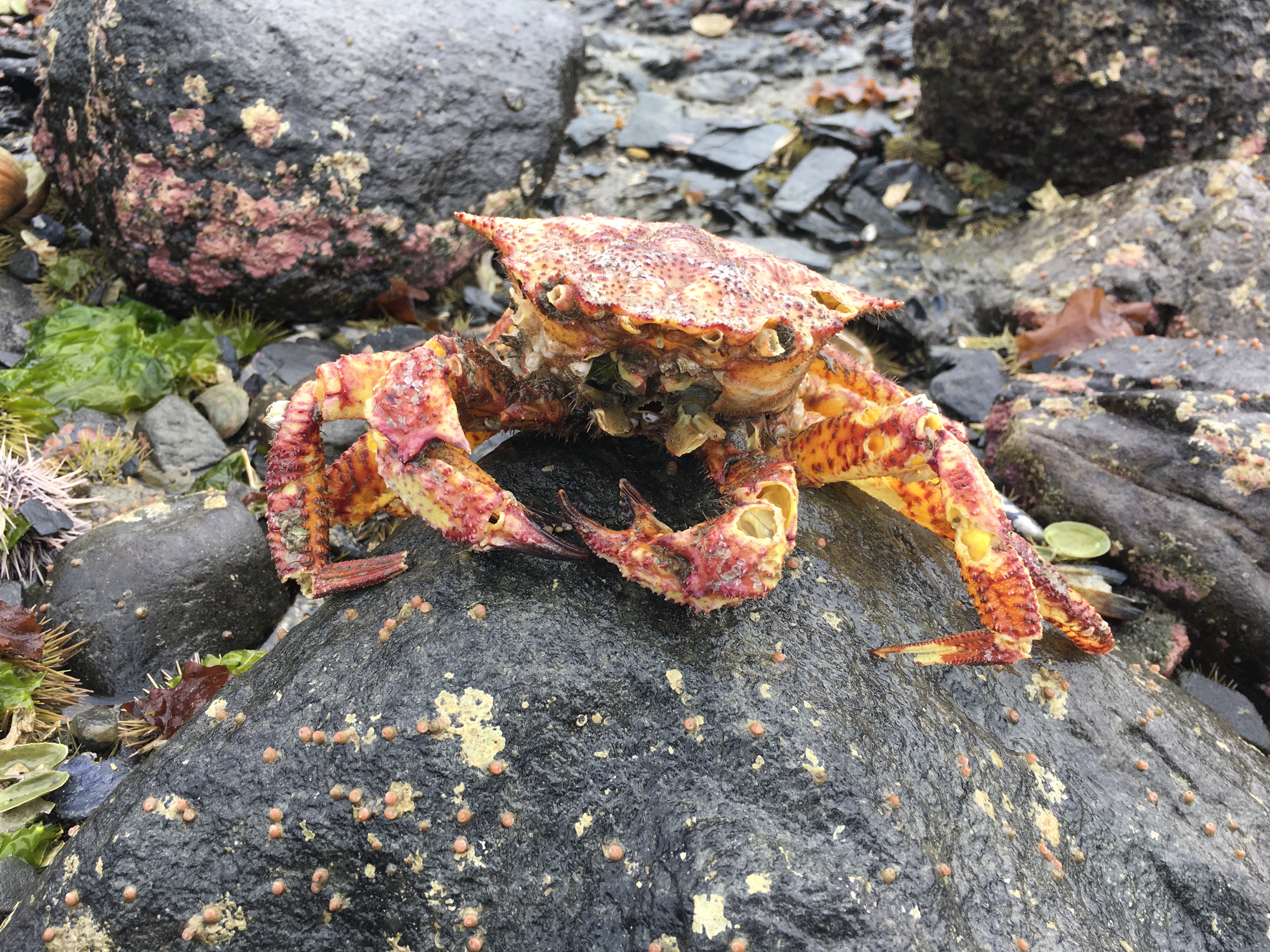
Bitter crab disease: Bitter crab disease (Hematodinium perezi) is a fatal disease infecting snow crab (Chionoecetes opilio) in the Eastern Bering Sea. With collaborators at NOAA, I developed a spatio-temporal statistical model to understand patterns of bitter crab disease across the region over the past ~30 years, now published in ICES Journal of Marine Science. Our work can help to identify future risk of disease outbreaks and point potential management interventions (and their limitations).